Showing posts with label history. Show all posts

Tuesday, January 20, 2015

The Mighty Moto

What's up y'all?  Hey, can you believe that its 2015 already?  Where did 2014 year go? The thing about time feeling faster as you get older is so true. This is part of why I've been neglecting this little blog of mine, life is happening and I should probably pay attention. Anyway.


I think this is just resting bitch face.


 I want to share a recent obsession, the motorcycle jacket. I've always loved them but was never able to own one because they were either too expensive or the cheap fashion ones made for models. Models whose thighs are smaller than my biceps because this viking grew up doing heavy labor (rowing, archery, wood chopping, tilling; these things make for lots of upper body mass). So getting my arms into one was basically a NOPE.

DEFINITELY INTENTIONAL. Rock that bitch face.

Right now motorcycle jackets seem to be everywhere on women, particularly in television. I think it has to do with the uptick in female heroes in the DC and Marvel adaptations to the serial screen. As a geek and a feminist this makes my heart happy, but as someone who loves history it also makes me curious. Like many of the articles of clothing eventually labelled as classic, it had its origins in the military.  I decided to do a wee bit of digging to find out more about its origins.


As it turns out the moto is an evolution of the bomber jackets used during WWI.  Originally they were brown horse or cow hide which had a thickness that helped protect the wearer from the elements.  Here's an excerpt from a great BBC article.

 In 1928, Irving Schott, co-founder of the New York City-based outerwear company the Schott Bros, designed and produced the first leather motorcycle jacket with a zipper. He named it the Perfecto, after his favourite cigar. A shield against the elements (replacing the less efficient button-down motorcycle jackets of the time), this important new silver feature, with its asymmetric positioning, also allowed motorcyclists to lean over their bikes without cutting into the body. The original jacket featured a cropped, snug fit, with a D-pocket and lapels designed to snap down or fold over each other and zip all the way up

FINALLY!  That asymmetrical zipper is explained!  I'd been wondering for years the point knowing it had to root in functionality.  Not getting poked and chaffed by a zipper is definitely a plus for me.


Surprise face.
 Of course, when fashion appropriates things they like to add a bit of pretty or fluff. On the runway there are motos in every color for Spring and even pre-Fall (prefall? Like why do we need pre fall and resort? WHY?  Its dumb.). I love the one above that Felicity Smoak is wearing from Arrow. As a matter of fact, all the Arrow ladies rock them at one time or another. This floral moto shows up in another super hero show but I forget which one.


"You should see the other guy" bitchface
I should point out that Marlon Brando made the moto jacket in black a popular element among the young and rebellious crowd with the movie "The Wild One" and the James Dean in "Rebel Without a Cause".  I don't think this association will ever go away, either.  And while right now its "anything but black" among the fashion crowd, having a black one in your closet will be a classic, always.

I have two of them planned for in non-black to take me through the year. The way our weather has been lately I only need a really warm coat a couple months.  Sort of related I've been craving jackets and blazers to help mix and match outfits for work. I think the non-leather jackets well certainly help with that, especially on days I need to bring the bitchface.  Leather biker jackets certainly help set the mood.

For a bit more history reading, Fit NYC has an article here,  and another somewhat less reliable source here.

Friday, March 29, 2013

Challis - A History of Our Chalet's Namesake


Hello Chalet guests, have a seat and lets talk a little bit about the history of our namesake, challis.

According to the dictionary is a lightweight plain-weave fabric of wool, cotton, etc., usually with a printed design. Which is all well and good, but doesn't really give us more information than that. So I figured I'd start with what a "lightweight plain weave" means.  Enter a text book from 1925*.

Click to embiggen.
"A plain weave" is where one weft yard passes evenly over one warp yard. This takes the least amount of material to make and is very inexpensive. The book goes on to say that challis is made from cotton and wool (rayon has not yet caught on).

Wool challis is light and soft and recommended for dresses and negligees. It will cost you (adjusted for inflation) anywhere from $13-25 dollars per yard (no wider than 39").


Cotton challis, however, is considered for inexpensive dresses and "comfortables" (lounge wear, I'm assuming).  This will run you anywhere from $2.50 to $24 a yard (also, no wider than 39").  

Now lets fast forward about 15 years, just before WWII was really under way. Chemists had been working on improving rayon, or "viscose" as it were to make it easier and more cost effective to manufacture. Somewhere around the 20's it started being called "artificial silk" and, as I looked, was not yet more than a foot note in text books but popular among households, until the 30's and the Great Depression.  But here's info according to DuPont's timeline.

About the time of the 1940's, DuPont started pushing rayon through what I can only assume are the original "infomercials".  I found an example from 1940 itself.


But rayon, and coincidentally, rayon challis, didn't catch on until the USA was fully embroiled in  WWII and rationing started.

After this country entered World War II practically no staple clothing fabrics of prewar quality were manufactured for the civilian. Some of the materials that homemakers used during peacetime in enormous quantities to clothe their families virtually disappeared from the civilian
consumer's market. No 80-square percale, no fine-count two-ply broadcloth or voile, and little gingham, chambray, muslin, nainsook, lawn, or poplin was available. These shortages were due in part to Government regulations which directed enormous quantities of textile goods to the armed forces. In order to stretch as far as possible the small amounts of fiber available, there was also a lowering of quality of textile materials made for home folks.
By the spring of 1944 the supply and variety of serviceable cotton fabrics were limited. The prewar backlog of materials of good quality was used up and the flow of these fabrics from the factories to the stores had almost ceased. In the small cities and towns, particularly those near military bases or camps, the shortage of staple materials was acute. Many of the few fabrics available, particularly the cottons, were so unattractive in design and color that they obviously would not have sold readily, if at all, in normal times. Rayons were generally more plentiful and more comparable to prewar fabrics than were the cottons, but some types of rayons were scarce. Wool and wool mixed fabrics were more plentiful than the cottons. Mixtures of wool and rayon were common, but few wool and cotton mixtures were on the market.
From early in 1944 until several months after the end of hostilities, homemakers in various parts of the United States found many of the available staple clothing fabrics so coarse and sleazy that they scarcely justified the money spent for 'hem or the time and energy used to make th jloth into garments. Many of the fabrics shrank and were faded by light and washing.

The relatively large volume of "too poor" fabrics might have been replaced by a smaller volume of materials of better quality if minimum quality standards had been set up for textile goods. Such standards under Government control would have prevented textile raw materials from being manufactured into inferior fabrics in this period of scarcity.
Before World War II considerable progress had been made in determining the physical characteristics of cotton woven goods such as broadcloth, chambray, gingham, and percale (5, 6,16,17).2
Federal specifications developed for the use of Government agencies in purchasing these goods have been in existence for several years (11, 12,13, 14). In these specifications for broadcloth and chambray differences in quality have been
designated. On the other hand, the quality of other classes of cotton and of various types of wool and rayon fabrics is not so generally known. The quality of various kinds of mixed fabrics composed of cotton, rayon, wool, and other fibers needs to be studied since they are becoming more and more common. Some of these fabrics are included in this study. Found here in Google Books, Quality of Fabrics Study in 1946
So, in essence, rayon and particularly challis, became popular because what else was there to use? Here are some vintage samples.


Source: etsy.com viaLady on Pinterest


Source: etsy.com viaLady on Pinterest


Source: etsy.com viaLady on Pinterest


Well, that concludes today's lesson. I hope you enjoyed it and learned something new!

Sunday, March 20, 2011

Washing Machines


How often do you think about your washing machine? I mean really give it some thought. I bet most people don't until it breaks or they move out of their parents' place and have to haul everything to the laundry mat. Or back to Mom and Dad's for the monthly visit. And maybe we even give it a bit of thought when we have to wash our dedicates by hand in the sink.

It was a couple things that made me start thinking about this history of the washing machine. One was a box of OLD cotton thread Mom gave me. All these bits are on wooden spools and on the stickers it says "boil safe". Boil safe? What? I asked about it and was told "Well, that used to be the only sure way to get your clothes clean. You had to boil the water and then stir them with soap, wring them out by hand".

Oh. My. God. The sheer amount of work involved JUST TO DO LAUNDRY? Just the thought made me cringe and I'm sitting here on my fourth load in to the seven that piled up from handling numerous crises the past few weeks. Could you imagine having to do all that by hand. Uhg. Excuse me while I go hug my washer and dryer for a moment. *HUGS*


So what's the second thing that made me think about our modern washing machines? An old story my Dad told me about when he was a kid growing up on a farm in the late 30's, early 40's. See, it was around this era that the "rural electrification project" was going on. They had offered my great-grandpa $100 to build the power lines through his cow fields. He was no slouch, that man, and instead bargained to have them wire his farm house up for electricity and have it be provided FOR FREE for as long as the family owned the farm. This means they had electric lights but no running water.

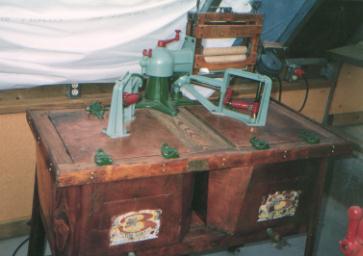
This also meant that great-grandma was the first to own an electric washing machine in the entire state of Maryland. It most likely looked something akin to the above contraption. The lack of running water meant that on laundry day all the kids were hauling buckets of water up and down the hill from the well, but they had to steer clear of the machine as it had no safeties. This means anything caught in the gears was likely to be taken clean off, including fingers and limbs. And this was still considered less manual labor than doing it by hand.

When the next generation of washing machines came out wanna guess what one of the major selling points was?


"SAVES WOMEN'S LIVES!"

That's right. Safety precautions are being built in, and soon you have the "double tank" machines. You could even boil the water right in the machine. How's that for progress? Makes you really appreciate your washer and dryer, or even the laundry mat, that much more doesn't it?

I highly recommend clicking on the above link and reading through the articles. Among some of the more interesting tidbits was the fact that there is no clear inventor of the original washing machine. I've tried to contact the author of the website and those papers with little luck. Even still, it was obvious the gentleman had put many hours of research and labor to bring us the history of this very under-appreciated invention.

Can you think of any more under-appreciated labor saving inventions in your house?

Addendum: After a little more digging I also discovered there is a big link between the electric sewing and washing machines and the Women's Liberation movement.